the Options Playbook with Tony Battista
Most retail traders fail for one simple reason: they trade too big, chase unhedged direction, and rely on hope rather than probabilities.
In a recent episode of Money Strategies, Mark Lewis sat down with Tony Battista—a 25-year veteran Chicago Board Options Exchange (CBOE) market maker and a foundational force behind financial powerhouses like thinkorswim and tastylive.
Together, Mark and Tony went deep into the mechanics of institutional trading, the realities of scaling a financial media company, and why managing risk beats predicting stock direction every single time.
1. The Origin Story: Lessons From the CBOE Pit
Long before digital trading apps and instant order execution, trading happened in the high-stakes, chaotic pits of the CBOE. Tony’s journey began on the floor as a runner, eventually rising to become a seasoned floor market maker.
Speed & Discipline: On the pit floor, hesitation meant lost capital. The pit taught traders to manage risk in real time under extreme pressure.
Probability Over Prediction: Market makers don't bet on whether a stock is going up or down; they price risk, capture implied volatility, and rely on statistical edges over long time horizons.
2. Why Retail Options Traders Lose Money
When retail traders transition to options, they often carry equity-market habits into a high-leverage environment. Tony highlighted the primary traps that cause retail accounts to blow up:
Trading Too Big: The single biggest mistake retail traders make is sizing positions too large relative to account balance. When position sizing is too aggressive, a standard market swing forces a margin call before the trade can work in your favor.
Chasing Direction & High-Yield Premiums: Trying to guess earnings or stock direction is a coin flip. Institutional strategies focus on probability of profit (POP), mechanics, and consistent portfolio management rather than home-run swings.
3. Building Institutions: thinkorswim & tastylive
Beyond his trading career, Tony played a pivotal role alongside Tom Sosnoff in building platforms that transformed retail finance—first with thinkorswim (later acquired by TD Ameritrade) and subsequently tastylive (tastytrade).
Customer Retention & Education: Scaling a multi-million-dollar financial brand isn't just about software; it's about education. By demystifying options mechanics and broadcasting live, transparent trades daily, they created an engaged community of mechanical traders.
Empowering the Self-Directed Investor: The mission has always been clear: give individual traders the exact tools, data, and probability-based frameworks that floor traders used to protect capital and extract income.
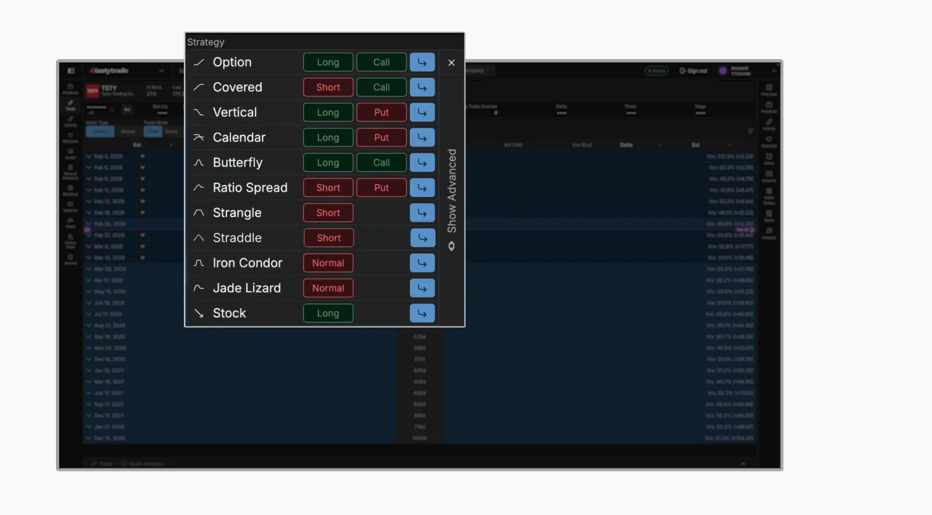
Tasty Trade
4. The Intersection of Wealth Generation & Preservation
For high-earning entrepreneurs making $1M+ ARR, generating liquid cash is only half the battle. Whether you're running a corporate enterprise or deploying capital in the options chain, the principles remain identical:
Systematize Your Framework: Just as you wouldn't run a business without strict operating procedures, you shouldn't put on a trade without a defined entry, exit, and risk management plan.
Protect the Principal: Wealth isn't built by taking reckless risks—it's built by managing downside exposure so your assets can compound over decades.
Stream the Full Episode
Catch the full conversation between Mark Lewis, EA and Tony Battista on Mark's Official Site or subscribe to the channel on YouTube to catch future episodes on tax architecture, options trading, and wealth preservation.
